What to do, and what not to do
Checked September 2026
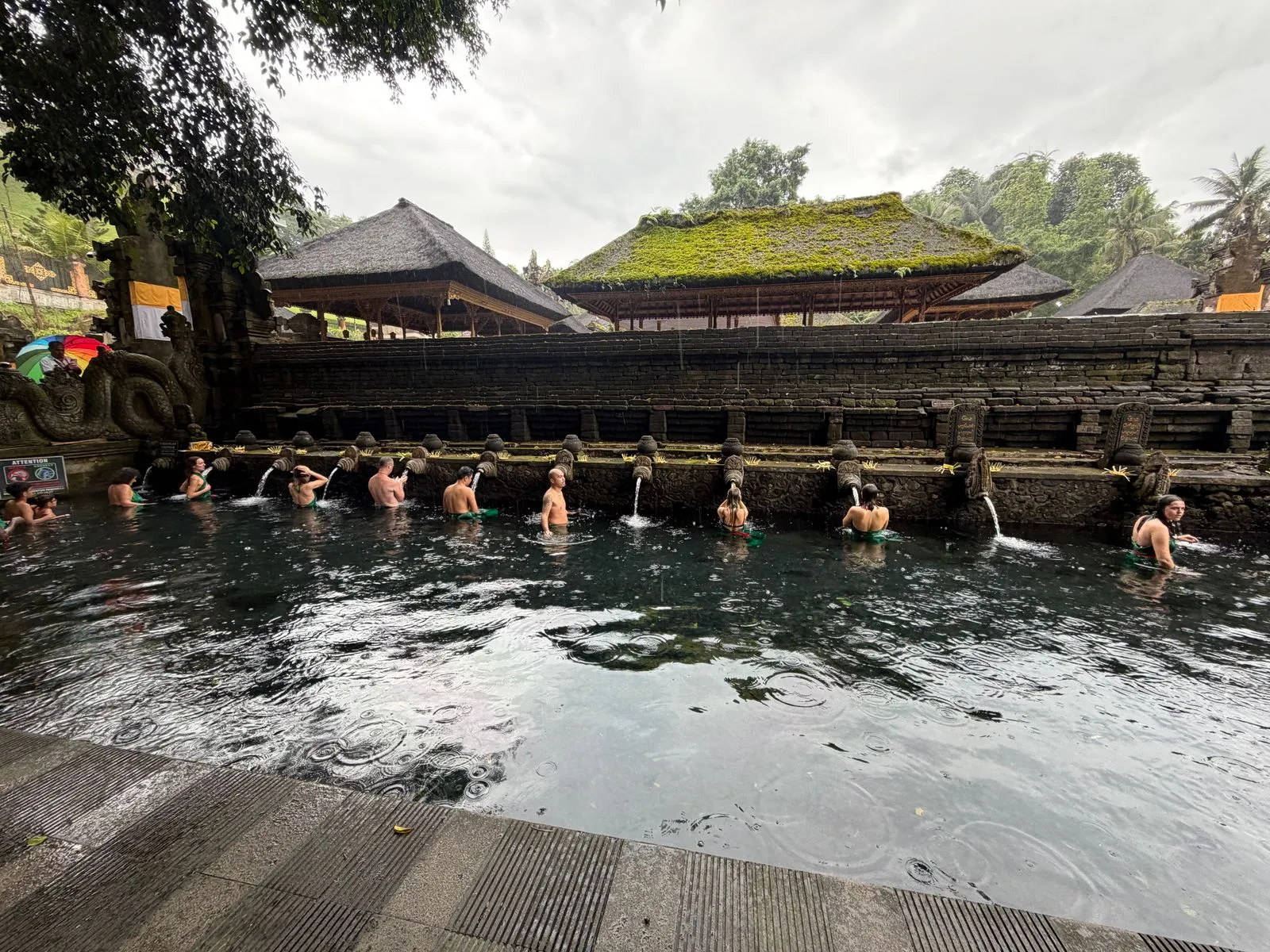
The sarong goes on before you reach the gate
Every working temple expects legs covered below the knee, men and women alike, and shoulders and back covered. A tank top will not pass. Over the sarong goes a sash, the selendang, tied at the waist; it is symbolic, and it is the part visitors skip. Large temples lend both at the gate, small ones often do not.
| At the gate | Rough cost |
|---|---|
| Sarong and sash | Lent free at major temples or about IDR 10,000–20,000; your own set about IDR 50,000–100,000 |
| Donation or entry fee | Set per temple; one guide quotes IDR 20,000–50,000 |
At Tirta Empul the sarong is rented at the entrance for a donation and you bathe in it, not a swimsuit. The spouts are used in sequence, and two of them are for cleansing the dead, not the living.
Where you may go, and where you may not
This part is not custom, it is written down. Governor’s Circular SE 7/2025 forbids foreign tourists from the innermost and middle courtyards — Utamaning and Madyaning Mandala — unless they are there to pray, in Balinese prayer attire, and not menstruating. The menstruation rule is in the circular, not only in temple custom; Balinese Hinduism treats it as a temporary ritual state rather than a judgement of anyone.
Guides also report temples asking pregnant women and anyone with an open wound to keep out of the sacred areas; that is custom, not the circular. The circular does ban climbing sacred trees and sacred structures, and photographing yourself on them immodestly dressed or undressed.
Feet, height and the camera
Keep your head lower than the priest and the sacred objects: no standing on a wall, a shrine base or a statue plinth for a better angle. Do not walk in front of anyone praying. Move clockwise through the courtyards.
Do not point your feet at people, shrines or images; sit cross-legged or with your feet tucked behind you. Where you see shoes left at a door, leave yours with them.
Photography is usually fine in the outer courtyard and not during prayer, but there is no Bali-wide rule: read the signs and ask. No flash, ask before photographing a priest or a worshipper, do not block a prayer space. Temple signs widely ban drones and vlogging. If a ceremony is running, put the phone away — a ringtone in the middle of chanting is the loudest thing in the building.
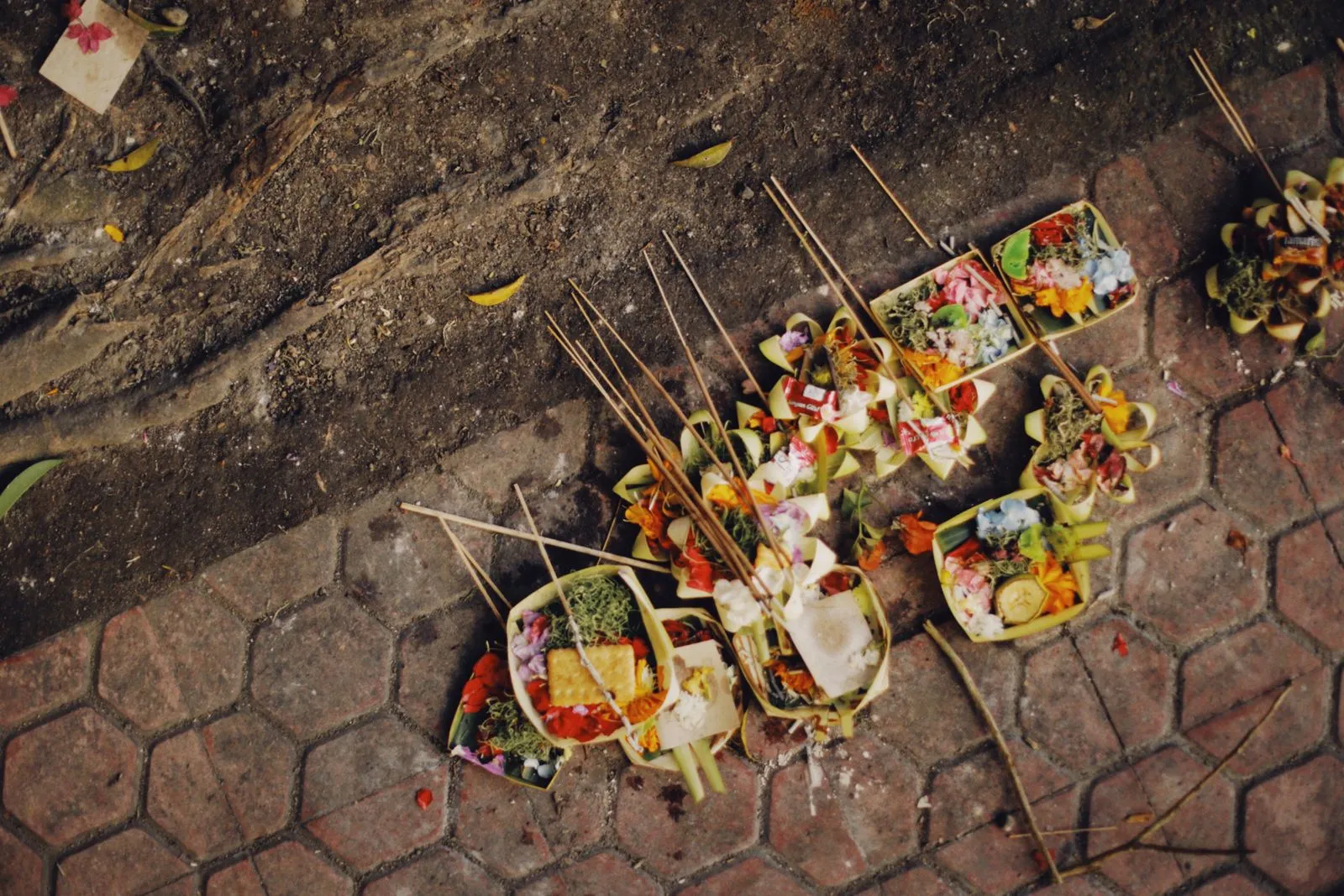
The little trays on the ground
Canang sari are the palm-leaf trays of flowers, rice and incense on pavements, steps, doorways and car bonnets. They are placed several times a day and left where they are until swept up.
Do not step on them or over them. Walk around, even when that means stepping into the road on a narrow Ubud pavement. Nobody will say anything if you tread on one, which is why visitors keep doing it.
Hands, heads and volume
The left hand is considered unclean: give, receive and eat with the right. Money goes across with both hands or the right, never tossed onto a counter. Do not touch anyone’s head, including a child’s — the head is the seat of the spirit. Point with an open hand or your thumb rather than one finger.
Raising your voice loses the argument before it starts, and it is not only manners: swearing, rude behaviour and causing a disturbance are named prohibitions in SE 7/2025, as is aggression towards locals or officials, including online.
When a procession meets you on the road
It will happen, usually on a road with nowhere to go: gamelan, umbrellas, people in white, and the whole carriageway.
Pull over, switch the engine off and wait. Do not thread through it, do not use the horn, do not overtake the tail of it. If police or pecalang — the traditional village security — are directing traffic, do what they signal. You may watch and photograph from the side, quietly.
Ceremonies follow the Balinese calendar, not the tourist one, which is why our guides assume the road will not cooperate.
Nyepi is not negotiable
Nyepi, the day of silence and the Balinese new year, falls on Monday 8 March 2027 under the government’s joint ministerial decree, and runs 06:00 to 06:00 the next morning. Some sites print the 9th; the decree says the 8th.
The four restrictions — Catur Brata Penyepian — are no fire or light, no work, no travel, no entertainment. A visitor stays inside the hotel or villa grounds for the full twenty-four hours, curtains drawn and sound down. The pool is usually open by day if you are quiet. Shops, restaurants and bars are shut and hotels serve limited or pre-packed meals, so buy what you want to eat the day before. Pecalang patrol and send people back indoors. Hospitals and emergency services keep running.
In 2026 the island closed comprehensively: the airport suspended commercial flights for twenty-four hours under a NOTAM, the Gilimanuk and Padangbai ferries stopped, the toll road and four nature parks closed, and mobile data went off while hotel WiFi stayed on. The 2027 equivalents were not published at the time of writing, so check with your airline nearer the date.
The eve of Nyepi brings the ogoh-ogoh parades, with road closures and firecrackers. Visitors may watch. Confirm the date locally; several sites have the year’s dates wrong.
Away from the temple
SE 7/2025 asks for modest, reasonable and appropriate clothing at sacred sites, attractions and public places, without listing garments. The line is geographic: swimwear on the beach and at the pool, covered up in a village, market or warung. A bikini top in a village street is not a style choice to the people who live there, and in Canggu or on Nusa Lembongan sand and village are two minutes apart.
It also asks foreign tourists to use a licensed guide at cultural and natural sites, change money only where the changer holds Bank Indonesia authorisation and its QR code, pay in rupiah, hold a valid licence and wear a helmet, use registered four-wheeled rental vehicles, stay in licensed accommodation and avoid single-use plastic.
Drone rules are tightening and the detail circulating online is not something we could confirm from an official source. Temple signs ban drones outright; check the current position before you fly one.
The levy: IDR 150,000, paid once, online
Every foreign visitor pays a tourist levy of IDR 150,000, about eight pounds, under Bali Provincial Regulation No. 2 of 2025. Pay at lovebali.baliprov.go.id or in the Love Bali app and a QR voucher arrives by email. Keep it on your phone: it is checked at the larger sites, and non-payers can be refused service at attractions.
Use the official site or app and nothing else: lookalike sites exist, and anything charging more than IDR 150,000 is not the government. An exemption process exists, but its criteria were not visible when we looked.
What actually gets people fined or deported
The circular sets no fine scale of its own: violators face sanctions or legal process under Indonesian law. It is an administrative instruction rather than a statute, so the penalties that bite come from national law.
Overstaying a visa costs IDR 1,000,000 a day. Working without the right documents can bring fines, detention, deportation and a blacklisting, which is what most deportation stories turn out to be. Cannabis in any form, including CBD and edibles, is illegal. On the road the statutory maximums are IDR 1,000,000 or four months for no licence, and IDR 250,000 or a month for no helmet, with the rider liable if the passenger has none.
Roadside stops are a different subject. Riders report being asked for cash at checkpoints, and report being offered a written ticket, blue or pink, when they ask for one. That is what travellers describe, not police procedure, and we will not present it as such. What is documented is that enforcement has grown and that insurers decline claims when the rider had no valid licence category or no helmet.
None of it is difficult, and most of it costs nothing. The visitors who end up in trouble are rarely the ones who misread a courtyard sign. We wrote the map walking into these places as visitors, under the rules on this page, which is the only reason we know which of them are enforced at the gate.
Tours and tickets in Bali
Booked through GetYourGuide, who choose what appears here and pay us a commission if you book. These are not our picks and we have not checked them — our own recommendations are the places on the map. How this works